Tuesday, March 22, 2016

Chapter 17: Section 3: Modern Classification

The phylogenetic analysis of RNA nucleotide sequences by Carl Woese led to a new version of " The tree of life".  This now contained three domains, and 6 kingdoms. 

Three Domains: Bacteria, Archaea, and Eukarya

Domain Bacteria : Each bacteria has a cell wall, a plasma membrane, a cytoplasm lacking complex organelles, and at least one circular chromosome. ( With Kingdom Eubacteria)

  • small
  • single-celled
  •  prokaryotic 
  • usually have a cell wall 
  • usually reproduce by binary fission 
*The oldest known fossils of cells appear to be bacterial cells 

Domain Archaea: Found in extreme environments, scientists think that they were among the first organisms on Earth because of their unique adaptations ( With Kingdom Archaebacteria) 
  • single celled
  • prokaryotic
  • distinctive cell membranes
  • unique biochemical properties 
  • some are autotrophic and are able to produce food by chemosynthesis
Domain Eukarya: 
(Includes the kingdoms Protista, Fungi, Plantae, and anamalia) 
  • Eukaryotic cells
  • large cells 
  • true nucleus
  • complex organelles
Kingdoms: Eubacteria, Archaebacteria, Protista, Fungi, Plantae, Anamalia

Kingdom Eubacteria: Prokaryotic cells, cell walls containing peptidoglycan, cell membranes containing fatty acids, unicellular, heterotrophic and autotrophic by either photosynthesis or chemosynthesis

Kingdom Archaebacteria: means ancient bacteria, Prokaryotic cells, cell walls lacking peptidoglycan, cell walls containing hydrocarbons, unicellular, heterotrophic, autotrophic by chemosynthesis 

Kingdom Protista: Protists, eukaryotic cells that are not plant, animals, or fungi. 

Kingdom Fungi: Eukaryotic cells, Unicellular or multicellular, gain nutrients by absorbing rather than ingesting, cell walls made of chitin, cell membranes contain fatty acids. 

Kingdom Plantae: Eukaryotic, Multicellular plants, autotrophic, cell walls from cellulose,
cell membranes contain fatty acids 

Kingdom Animalia: Eukaryotic, Multicellular, heterotrophic, symmetrical body organization 

Chapter 17: Section 2: Systematics

Systematics: Classifying organisms in terms of their natural relationships
  •  A modern approach to taxonomy 
Biologists today may try to combine several systems of classification. However, most use Phylogenetics. 

Phylogenetic: The analysis of the evolutionary or ancestral relationships among taxa. 
Phylogenetic Diagrams: Shows how closely organisms within a subset of taxa are related, based on hypothesises. 
  • Several types of evidence are used to hypothesize, Including: Visible similarities, Embryonic development, Patterns of similar chromosomes, and Dna or Rna. 
  • The greater the number of homologous structures, the more closely related organisms are. 

 Cladistics: A system, of phylogenetic analysis that uses shared and derived characters as the only criteria for grouping taxa. 
                            Shared character:  A feature that all members of a group have in common
                         Derived character: A feature that evolved only within the group under consideration 
Clade: The group of organisms that includes an ancestor and all of it's descendants 
Molecular Cladistics: ( such as similar amino acids or nucleotide sequences), as well as chromosome comparisons, can help determine common ancestry 
Chromosomes: analyzing karyotypes can provide more information on evolutionary relationships , and are  independent of physical similarities and molecular data

Chapter 17: Classification

Biodiversity: the variety of organisms considered ay all levels from populations to ecosystems

What is classification?
Classification is the arrangement of organisms into groups/ categories called taxa, based on their similarities

classification is also known as taxonomy
Taxonomy: The science of describing, naming and classification
Taxon: any particular group within a taxonomic system

Aristotle was the first taxonomist
Naturalists replaces aristotles classification system because it did not adequately cover all organisms and the use of common names was problematic

Carolus linnaeus 1707-1778
18th century taxonomist
Classified organisms by their structure
*Developed naming system still in use today

Levels of classification ( largest to smallest):
Domain
Kingdom
Phylum
Class
Order
Family
Genus
Species

Binomial nomenclature: Each organism receives a scientific name with two parts: the genus name is followed by the species identifier.  ( Written in italics with the genus name Capitalized)

Subspecies: variation of a species that live in a different geographic area.

Wednesday, February 24, 2016

Heraldry and Chivalry ♚

Chivalry and heraldry-big ideas 
What were the moral codes knights were expected to live by?
What is heraldry and how was it used?

Chivalry- overview 
A knight was expected to not only have strength and skills in combat, but to temper this aggressive side with christian virtues .

Chivalry was a moral system which went beyond rules of combat to define the ideal conduct and qualities expected of knights, such as bravery , courtesy, and honor towards women.

Chivalry- defined
1. The combination of quarter expected of an ideal knight, esp. courage, honor, justice, and a readiness to help to weak
2. Courteous behavior, esp. towards women
3. The medieval system of knighthood
4. Knights, noblemen, etc


How do you know who is on your team?
Heraldry: System of symbols  for each identification
The use of these distinctive family symbols became known as " Heraldry"

A knight carried a shield inscribed with symbols or design that came out to be known as his " coat of arms"
A noble family's coat of arms was handed down from generation to generation.
Every part of the coat of arms were symbolic and represented characteristics.

Wednesday, February 17, 2016

Chapter 15 ( Theory of evolution)

Evolution: a change in characteristics within a population from one generation to the next

During the 18th century : most scientists believed that all species were permanent and unchanging, and that the earth was only thousands of years old.
*this was because they had calculated it based upon the bible.
Today: Species has changed over time and the earth is over 4 billion years old.


Ideas about geology:
Scientists in Europe begun studying rock layers, known as strata. They discovered that the lower strata developed first. 

Georges Cuvier (a french anatomist) promoted the idea of catastrophism: sudden geologic catastrophes caused the extinction of large groups of organisms in the past. 

Charles Lyell promoted uniformitarianism, which basically said that the same processes that were used in the past were still happening today to shape the earth in new ways.

Jean Lamarck supported the idea that populations of organisms change over time, which was true. However, he should've shut up after that. He proposed that individuals require traits during their lifetimes as a result of esxpirences or behavior, and then pass on those traits to offspring. His idea was called inheritance of acquired characteristics. This was untrue, because lamark didn't know how genes worked. It was proved wrong when a scientist cut off the tails of mice and the mice continually always had tails when they were born.

Darwin used the phrase decent with modification to describe the process of evolution. He reviewed the evidence that every species must have descended by reproduction from pre existing species and that species must be able to change over time. Although Darwin wasn't the first to think of decent with modification, he was the fist to apply it to all species. This was because we as humans stopped being weird about discovery and accepted things even if they didn't agree with our religious beliefs.

Sunday, February 14, 2016

tactics test ✓

Rhetoric:  the art of effective or persuasive speaking or writing, especially the use of figures of speech and other compositional techniques
Propaganda:  information, especially of a biased or misleading nature, used to promote or publicize a particular political cause or point of view
Logical Fallacy:  a pattern of reasoning rendered invalid by a flaw in its logical structure that can neatly be expressed in a standard logic system

speaker: who is speaking, writing, or composing the text
audience: who is listening, reading, or interacting with the text
subject: the topic of the text
purpose: the objective of the speaker--what he/she wants to accomplish through this text occasion: the motivation for composing the text tone: the emotion and attitude of the speaker towards the text and / or audience appeals to emotion (pathos): attempts to lure the audience by urging them to think or act a certain way by focusing on their emotional response appeals to logic (logos): attempts to lure the audience by urging them to think or act a certain way by focusing on logical arguments built from solid reasons and evidence appeals to credibility(ethos) : attempts to lure the audience by urging them to think or act a certain way by focusing on their connection to and knowledge about the speaker 
claim: main argument posed in the text reasoning: scientific, moral, aesthetic, philosophical, economic, or historical thought structure that answers the question Why do you believe what you believe? evidence and support: facts, data, quotations, etc. from authoritative sources to enhance the speaker’s reasons counter argument : addressing the claim that are in opposition to the speaker’s claim; this usually is following by “shooting down” these positions with additional reasoning and support concession: acknowledging when the other side has a valid point, potentially a point that the speaker cannot refute; this can be followed by “shooting down” these positions with additional reasoning and support


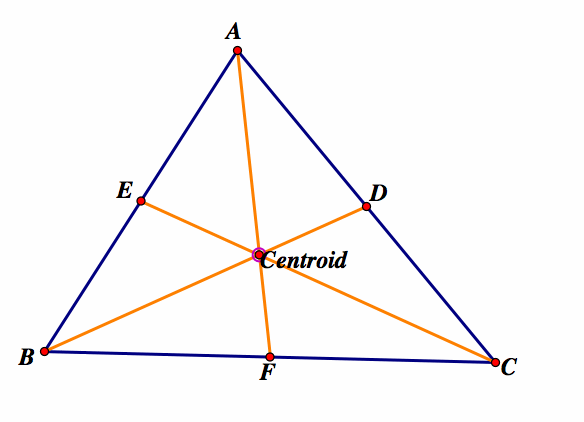
Point of concurrency △


If two or more lines meet at a single point, the lines are concurrent, and the point at which they meet is called The point of concurrency 

The median of a triangle ( orange lines) are the segments from the vertex of a triangle to the midpoint of the opposite side.

The point of concurrency of the median is called the centroid.


The centroid is important because it divides the median into a 2:1 ratio. The section of the median nearest the vertex is twice as long as the section near the midpoint of the triangle's side.

*If the triangle is obtuse, it is likely for the point of concurrency to fall outside the triangle.


The coordinate of the centroid is the average of the coordinates of the vertices. 

For example: you have triangle a,b,c. a( 0,-6) , b(-10,-6), c(1,0)
so the x of the centroid would be ( 0+ -10 + 1) / 3  = -9/3 = -3.    x=-3
and y would be (-6 + -6+ 0)/3 =-12/3 = -4.  y=-4

therefore, the coordinates would be (-3,-4)


For problems such as : two vertices of a triangle are ( 0,0) and ( 9,0). the centroid is (6,1). Find the third vertex of the triangle.

you would set up the equation as: (0+9+x)/3 =6   so what divided by 3 equals 6? 18. and 9+ 9= 18. so x=9.

for y, (0+0+y)/3= 1 therefore, y must equal 3. because 3 divided by 3 is equal to 1.